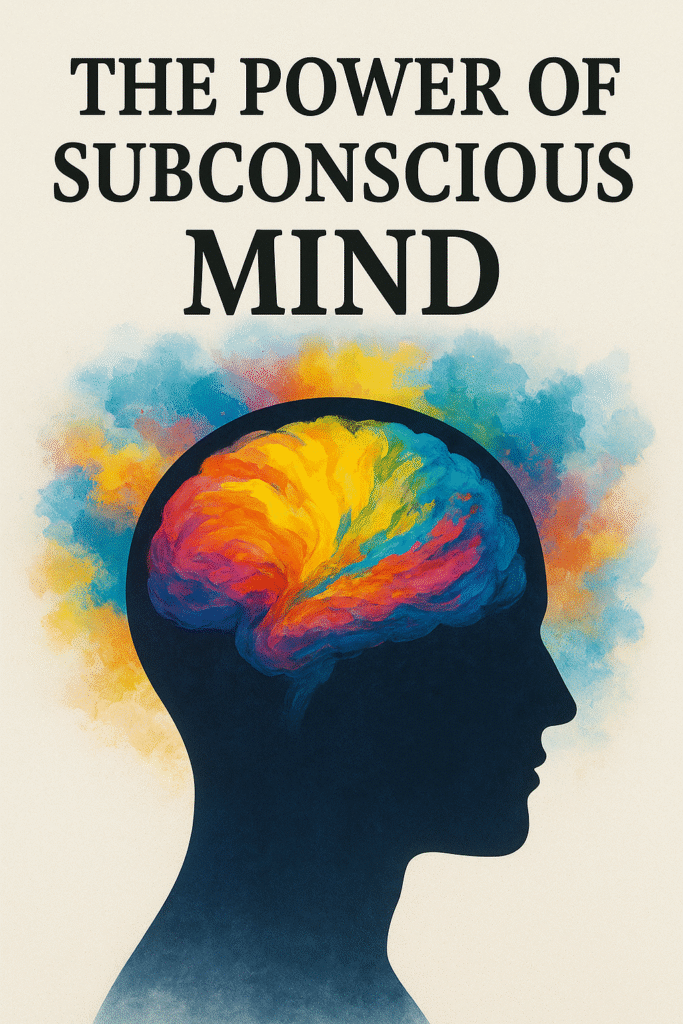
Book Review — The Power of Your Subconscious Mind: A Modern Look at Manifesting That Actually Works
Introduction — Why this book still shapes the way we understand manifesting
If you’ve ever explored manifesting—not as a mystical shortcut, but as a deliberate shift in mindset, habits, and perception—Joseph Murphy’s The Power of Your Subconscious Mind sits at the foundation of almost everything you hear today.
Although the book was first published in 1963, it remains a bestseller and continues to influence fields ranging from self-help and psychology to personal finance and spiritual development. (Sources: Open Library, Goodreads best-seller data.)
Murphy’s premise is simple but surprisingly modern:
Your subconscious mind accepts repeated thoughts as truth, and over time, those beliefs direct your behavior, decisions, and outcomes.
Manifesting, in this context, isn’t magic. It’s the alignment of thought, expectation, and action. My goal in this review is to unpack the book’s claims, compare them with current research in neuroscience and psychology, and help you apply the ideas in a grounded, practical way.
How Murphy’s ideas compare to modern science
The table below gives a quick side-by-side look at Murphy’s claims vs. what current research supports.
📊 Comparison Table — Murphy vs. Modern Science
| Topic | Murphy’s View | What Evidence Shows Today |
|---|---|---|
| Role of the subconscious | A programmable spiritual force that obeys “mental commands.” | The unconscious mind shapes perception & behavior through automatic cognitive processes. (Supported by modern psychology and neuroscience research.) |
| How to change reality | Use affirmations, visualization, and faith-based statements. | Use habit loops, cognitive reframing, mental rehearsal, and consistent behavior change. |
| Speed of change | Suggests rapid transformation is possible with intense belief. | Change happens incrementally; repetition builds neural pathways (“neuroplasticity”). |
| Manifesting outcome | Thoughts directly influence external events. | Thoughts influence behavior, which influences results — not instant external change. |
This framing is important because it transforms manifesting from a mysterious force into a strategic psychological tool.
What the book gets right about manifesting
Murphy’s writing blends spirituality, psychology, and anecdotal storytelling. While not all of it aligns with evidence, several timeless principles still hold up — especially when interpreted through a modern lens.
1. Repetition shapes identity — which shapes results
Murphy emphasizes repeated affirmations as the primary tool for influencing the subconscious.
Modern behavioral science agrees:
Repetition rewires neural pathways and shapes identity. And identity drives action.
In manifesting terms:
What you repeatedly believe becomes what you unconsciously act on.
A practical example:
If you repeatedly affirm “I attract opportunities,” your brain becomes more attuned to noticing and pursuing those opportunities — a cognitive bias known as “selective attention.”
The key is consistency, not intensity. Murphy’s message aligns with how neuroplasticity works today.
2. Visualization influences decision-making
One of the strongest points in the book is Murphy’s insistence on vivid mental imagery.
Modern neuroscience confirms that mental rehearsal activates nearly the same neural circuits as real experience.
That’s why athletes visualize.
Why surgeons rehearse.
Why public speakers mentally walk through a stage performance.
Manifesting is essentially visualization aimed at life design.
Murphy’s contribution is helping readers approach visualization as a daily ritual, not a one-off exercise.
3. Belief affects behavior (and behavior creates outcomes)
When Murphy talks about faith and conviction, he’s tapping into what psychologists now call expectancy theory:
Your expectations influence your motivation and the quality of your performance.
A 100% belief in an outcome isn’t necessary — but a belief in possibility shapes persistence, risk-taking, and resilience.
This is one of the book’s most practical contributions to manifesting today:
Changing your internal story changes the kinds of choices you make.
4. “Blocks” and “resistance” are real — just psychological
Murphy frames resistance as subconscious fear or negative belief.
What he’s describing actually maps to:
- Cognitive distortions
- Fear-based avoidance
- Confirmation bias
- Low self-efficacy
- Learned helplessness
These concepts are widely supported in cognitive psychology.
In manifesting terms:
You can’t attract what you fundamentally believe you can’t handle or don’t deserve.
This is where Murphy’s work is profoundly valuable — it gives readers permission to rewrite deeply embedded beliefs that sabotage success.
Where Murphy’s ideas need a modern update
While the book offers powerful mindset tools, some claims overshoot the evidence.
1. The “instant manifestation” stories feel unrealistic
Murphy recounts tales of overnight healings, sudden financial windfalls, or miraculous reconciliations.
These make for inspiring reading, but they’re anecdotal and not replicable.
In real-world manifesting:
- Change is gradual
- Habits matter more than hoping
- Systems outperform affirmations
Instant results may happen, but they aren’t predictable or universal.
2. The language is often overly mystical
Murphy uses spiritual terminology that can feel disconnected from practical application — especially for analytical readers.
To make the book more actionable, I reinterpret his spiritual metaphors using psychology and neuroscience.
This makes manifesting less about magical thinking and more about intentional thinking.
3. There’s no emphasis on execution
Manifesting requires aligned action.
Murphy touches on this, but lightly.
Today’s successful manifestors are the ones who pair mindset with measurable steps:
- Planning
- Testing
- Incremental progress
- Behavior tracking
- Environmental design
Manifestation without execution becomes fantasy.
Execution without mindset becomes burnout.
The magic is in the combination.
A modern framework for applying the book to manifesting
Below is a step-by-step system that merges Murphy’s philosophy with evidence-based practice.
🧠 Step 1: Choose a specific manifestation goal
General intentions = general results.
Specific intentions = measurable progress.
Example:
Instead of “manifest abundance,” try:
“I am creating an online offer that earns $3K/mo.”
🎨 Step 2: Visualize the outcome daily
Keep it short — 3 minutes is enough.
Focus on sensory detail: what you see, hear, feel.
Visualization works best when it triggers emotion and anticipation.
🪞 Step 3: Reframe limiting beliefs
List beliefs that contradict your intention.
Rewrite each into a possibility-based statement.
Old belief: “I’m not good at sticking with goals.”
New belief: “I can improve my consistency with small steps.”
Small shifts compound into identity change.
🔁 Step 4: Use affirmations as habit cues
Murphy loves affirmations — but modern science tells us affirmations must be tied to behavior.
Example:
Affirmation: “I create opportunities.”
Behavior cue: Spend 10 minutes daily connecting with new people.
Affirmation ignites intent.
Behavior fulfills it.
⚙️ Step 5: Take aligned micro-actions
Manifestation ≠ forcing
Manifestation = direction + motion
Replace “massive action” with:
- Tiny experiments
- Daily 1% improvements
- Environment shaping
This is how the subconscious integrates intention into routine.
📈 Step 6: Track synchronicities & data
Manifesting accelerates when you develop awareness.
Track:
- Unexpected opportunities
- Small wins
- Ideas
- Emotional shifts
Murphy would call these “signs.”
Modern psychology calls them “feedback loops.”
Either way, tracking reinforces belief.
Who this book is perfect for
✔ You’ll love it if:
- You’re exploring manifesting with an open mind
- You enjoy the intersection of spirituality and psychology
- You want a mindset-first approach to achieving goals
- You appreciate classic self-help writing
✖ You may struggle with it if:
- You prefer strict scientific language
- You dislike anecdotal storytelling
- You want tactical business or productivity strategies
Pair it with books like Atomic Habits or Mindset and you’ll get a balanced, powerful system.
My personal takeaway — manifesting is mindset engineering
Murphy’s brilliance isn’t in his metaphors or miracle stories.
It’s in the simple, repeatable framework he gives us:
- Think intentionally
- Feel intentionally
- Act intentionally
- Reinforce intentionally
Manifesting isn’t magic.
It’s mindset engineering — and Murphy’s book remains one of the best manuals for understanding the inner mechanics.
Conclusion — Does this book really help with manifesting?
Yes — with the right interpretation.
If you read it literally, some claims may feel exaggerated.
If you read it as a guide to mental reprogramming, identity restructuring, and intentional living — it becomes a powerhouse.
The real value lies in:
- Training your subconscious
- Aligning belief with behavior
- Reframing fear and resistance
- Using visualization and repetition strategically
- Turning intention into consistent micro-action
Whether you’re a beginner or seasoned manifestor, The Power of Your Subconscious Mind offers timeless tools for shaping your inner world so your outer world follows.